HD9 economist, anthropologist, and activist Cynthia Wentworth recently wrote this excellent piece about my rail trip with community leaders and her advocacy for the future of the Alaska Railroad. Enjoy!
In 2024, Anchorage’s Municipal Assembly launched a program called “Nerds of Anchorage”. A rather odd name, to be sure–but a great program. Every few months, seven speakers are chosen to give a seven-minute speech about a municipal topic. Topics to date have been budget, transportation, water, soils, “Will You Be my Neighbor?” and “Great Ideas for Anchorage”.
On May 15, Nerds of Anchorage’s theme was “Great Ideas for Anchorage”. I gave a speech about commuter rail, titled “All Aboard”. My friend Graham, who is from Scotland, originally told me about Nerds of Anchorage, and encouraged me to speak about commuter rail there. He supports my efforts to bring an international perspective into the rail discussion. His brother takes a train from his home ten miles east of Edinburgh, into Edinburgh’s Waverly Station daily.
I too have British connections. Although my sister Dana and I were both born and raised in Anchorage, she moved to Oxford, England, as a young woman. She and my nieces, nephews, great niece and great nephew take trains all the time, and I do so also when I visit.
My “All Aboard” speech on May 15 caught the attention of Anchorage Assemblyman Daniel Volland, Chair of the Transportation Committee. He came up to me afterwards and asked if I could attend the Assembly’s Transportation Committee meeting on July 16. Graham was also in the audience, and he told Daniel about his brother taking the train daily into Edinburgh’s Waverley Station. Daniel was interested: “I’m also Scottish!” he said.
Discussion in the Anchorage Assembly Transportation Committee

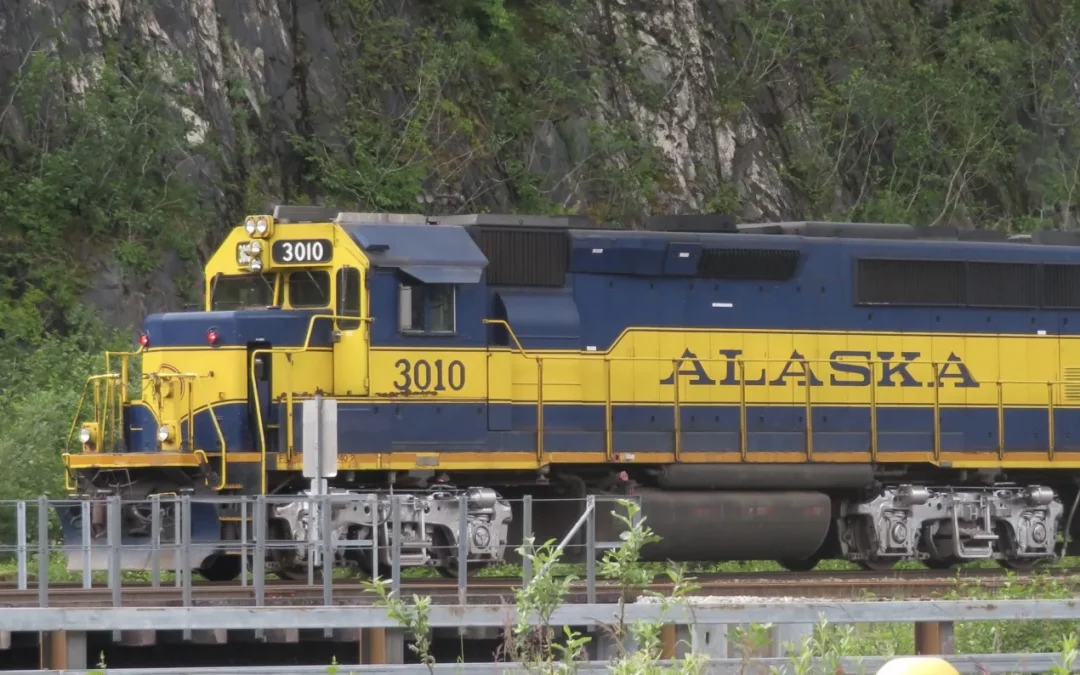
The Alaska Railroad en route from Whittier (photo: Shaina Kilcoyne)
On July 16, the Sierra Club’s Alaska Chapter Director Andrea Feninger, the Alaska Railroad Corporation’s Brian Lindamood, and I all addressed the Assembly’s Transportation Committee. Daniel Volland began by saying: “I heard a really interesting presentation at City Nerd Night, about the history of commuter rail, and ideas for the future.” Andrea introduced me as a member of Governor Walker’s 2018 Commuter Rail Advisory Task Force.
Andrea emphasized that our rail infrastructure is underutilized, particularly from October to April, even though we have three functional rail depots: Wasilla, Anchorage, and the airport. She said we’ve done enough studies – we want a pilot program (the Commuter Rail Advisory Task Force had proposed a pilot program, but the legislature did not have the funds). She talked about the crashes on the Glenn Highway, particularly in winter – something I had stressed in the Nerds of Anchorage speech – and that rail is one of the best transportation methods for reducing carbon emissions. I underlined Andrea’s emphasis on safety as well as the Muni’s Climate Action Plan: transportation accounts for 40 percent of GHG emissions in the Anchorage area, and rail gives off one third the emissions of highway use.
Then Brian Lindamood of the Alaska Railroad Corporation (ARRC) spoke. He said ARRC is a private corporation owned by the State of Alaska. He reminded us that it is housed in the Dept of Economic Development, not the Alaska Department of Transportation and Public Facilities. The Railroad shares Andrea’s belief: we don’t need another study; we’ve studied this for 40 years. It’s time to put trains on the track. He estimated $10 million per year in operating cost, as well as a one-time capital cost of up to $13 million for a siding in Wasilla. He said ARRC is applying for a passenger rail corridor, for daily service between Matsu and Anchorage, under the FRA Corridor ID Program.
Daniel Volland said this was really exciting. That we want to do what we can to support it. He said that since the train is already operational at the airport, for tourists, could we not have a narrower pilot program, taking Anchorage residents to the airport? Brian explained that ARRC could run trains where they are wanted, that there is a fixed cost for operating a train, so distance does not matter.
Although our commuter rail committee is non-partisan, the Democrats of Alaska House District 9 helped me with my May 15 speech. They also informed our State Rep. Ky Holland, about it (he is an Independent).
Rail leaders’ train excursion to Whittier

Whittier’s cruise ship facility, outside (Courtesy John Pursley)
Rep Holland, who, like me, was born in Alaska, has a special interest in Alaska’s rail history. On July 14 he sponsored a trip on the Alaska Railroad’s Glacier Discovery train for leaders and friends in District 9. Jim Blasingame, former Vice President of the Alaska Railroad Corporation, and Meghen Clemens, Railroad Host, External Affairs, joined us. We took the Glacier Discovery–some boarded in Anchorage, and I climbed aboard in Girdwood–to the port of Whittier, which is a part of District 9. Whittier is where rail barges dock and load railcars onto the railroad with freight destined for Anchorage and points north. It also has a cruise ship terminal and a boat harbor.
Whittier’s City Manager Jackie Wilde welcomed our group. We toured Whittier’s cruise ship facility, met city officials, and visited the Police and Fire Departments. We also visited the Prince William Sound Museum. A bus then took us out Shotgun Cove Road, passing the Begich Towers, a high-rise World War II era building, refurbished, where most town residents live.

Whittier’s cruise ship facility, inside (Courtesy John Pursley)
Whittier’s history began with its use as a Chugach Native portage route, later during World War II after a railroad was built into the area, in 1943, developing into a U.S. Army military port. For many years, the only practical way to access Whittier from Anchorage was by train. But in 2000, the Anton Anderson Memorial Tunnel opened for vehicular traffic, and people could drive.
For fun on the train ride, Ky gave all of us some rail trivia questions:
- Do you know where Glacier City is/was located?
- What was the largest city in Alaska in the summer of 1898?
- In 1913, Taft’s railroad commission recommended to Congress that two Alaska railroads be constructed. Where was the railroad from Seward originally headed?
- Bonus question, why was its destination changed?
Answers:
- Glacier City was the original name for Girdwood
- Sunrise, then Skagway
- The Alaska Railroad was originally headed to the Iditarod and Kuskokwim areas.
- Its destination was changed to Fairbanks because President Wilson opposed the Copper River and Northwestern Route, which was owned by the Morgan Guggenheim Alaska Syndicate and was also destined for Fairbanks. They were a huge monopoly. President Wilson wanted a publicly owned railroad to develop Alaska’s resources, not a private monopoly.
–by Cynthia Wentworth